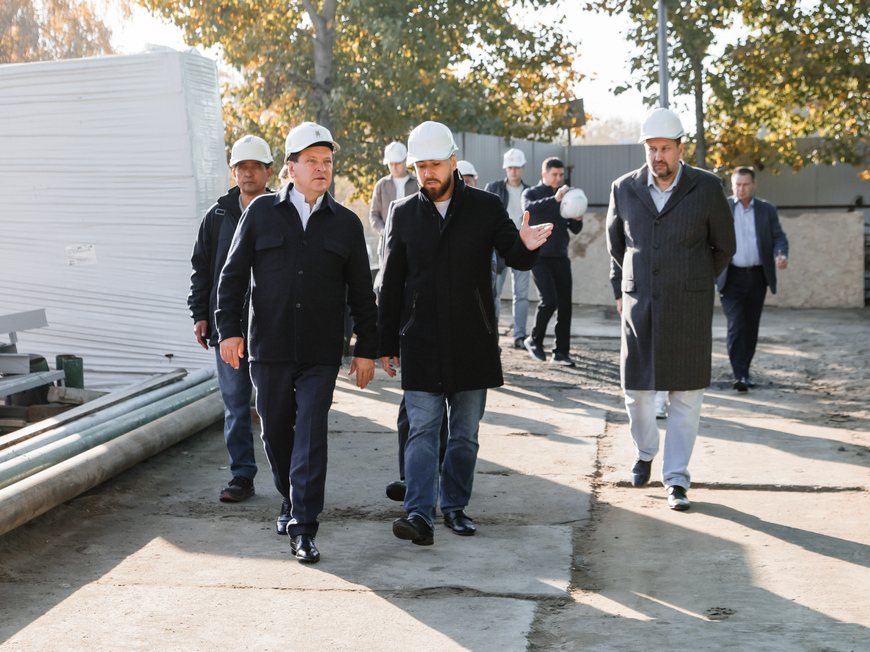
The construction of an electrical substation is nearing completion — it will supply the new Novaya Portovaya district with electricity
read more-
Within a five-year period, an additional 84,000 light sources have been installed in Kazan
-
Renovation of the banks of Lake Kaban and a new connection between Baumana and Profsouznaya streets
-
The Equestrian Complex in Mirny will be used to prepare for the Nomad Games
-
In Kazan, a new boiler house at the 33 Voenny Gorodok will supply heat to 3,300 residents
-
As many as 91% of the residential buildings and 95% of social facilities have been connected to the heating system in Kazan
-
Ilsur Metshin: “Waterside areas are the jewels of every city”
-
Ilsur Metshin takes part in the 1st International Forum of Port Cities in Kaliningrad
-
Ilsur Metshin on the Volunteer Center on Maksimova Street: “You have created a real center to help the front line”
-
Ilsur Metshin on the new equipment of Vodokonal: “It is very important to promptly eliminate accidents and blockages”
-
Renovation of tram networks and storm drains, as well as new medical centers: projects to be implemented in Kazan in 2027
-
The 5th Kazan International Legal Forum gathered 2,000 participants
-
Ilsur Metshin visits the Department of Food and Social Nutrition in Kazan
Ilsur Metshin visits the Department of Food and Social Nutrition in Kazan
A renovation of the administrative building of the Department of Food and Social Nutrition completed in Kazan. The facility, built in 1974, was renovated for the first time. Today, the Mayor of Kazan Ilsur Metshin visited the renovated building.
“The Department of Food and Social Nutrition is a strategically important enterprise for Kazan. It provides high-quality food for 310,000 residents of Kazan per day. Most of them are children: over 300,000 are schoolchildren and preschool children in Kazan, as well as residents of 10 nearby districts. This extremely important task for the city is carried out by a huge team – more than 1,000 workers. Every year, they cook 67 million meals. Therefore, it’s important to provide them with a good working conditions. That’s why we take a systematic approach to creating decent conditions for our colleagues so that they ensure healthy nutrition for our children,” Ilsur Metshin noted.
The administrative office with a total area of 1,500 square meters was renovated. The reconstruction made it possible to double the number of workstations. For one of the departments, which was previously located in another building, an open‑office space was set up here.
The renovation lasted a year and a half; a separate design project was developed for the building. The utilities, ventilation, and air conditioning system were updated; new equipment was installed in the server rooms and switchgear rooms. The workspaces were redesigned taking into account the specific requirements of the departments.
The open office accommodates the financial and accounting departments. The space was divided into work zones with sound-absorbing walls. There are meeting rooms, a print room, and a separate dining room.
The renovation involved not only the interior spaces but also the facade. The design preserves connection with Kazan and Tatar culture.
During the renovation, the historical details of the building were preserved. The old support rails on the staircases were illuminated. One of the rails is of German manufacture, dating back to 1910, and the other is domestic, dating back to 1916.
The exterior of the building was decorated with Tatar national elements, and the interior design kept traditional ornaments. The walls have images of the city’s iconic landmarks: Kul Sharif, the Kremlin, and other symbols. The interior’s color palette is based on beige, terracotta, and green shades.
The conference room is equipped with convertible tables. According to Rima Mukhamedshina, it can be used for studying, work meetings, and other team tasks.
At the entrance, a stand with photos of the best employees was installed. In the lobby, a meeting room was equipped, which can be used to hold meetings with visitors. Some of the stands are dedicated to the history of the food department, professional skills, occupational safety, awards, and achievements.