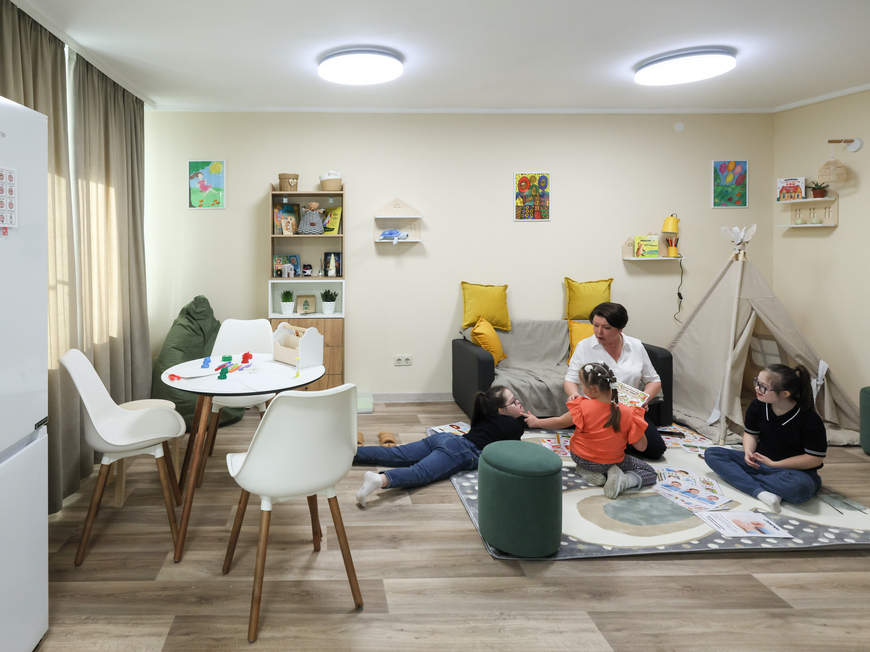
The Mayor of Kazan visits the new life-skills training apartment for children with special needs
read more-
Construction of the largest-capacity sewage pumping station in the Sovetsky district is in its final stage
-
This year, as many as 44 social institutions have been renovated in Kazan
-
Ilsur Metshin visits a new facility designed for children with intellectual disabilities
-
Ilsur Metshin takes part in the opening of the Architectural Forum «Dialogues»
-
Reconstruction of the Raketa stadium: spacious changing rooms and recreation rooms
-
The construction of an electrical substation is nearing completion — it will supply the new Novaya Portovaya district with electricity
-
Within a five-year period, an additional 84,000 light sources have been installed in Kazan
-
Renovation of the banks of Lake Kaban and a new connection between Baumana and Profsouznaya streets
-
The Equestrian Complex in Mirny will be used to prepare for the Nomad Games
-
In Kazan, a new boiler house at the 33 Voenny Gorodok will supply heat to 3,300 residents
-
As many as 91% of the residential buildings and 95% of social facilities have been connected to the heating system in Kazan
The Mayor of Kazan visits the new life-skills training apartment for children with special needs
A new facility for the adaptation of children with intellectual disabilities opens in Kazan at 59 Vosstaniya Street. The sixth in the city project by ANO ‘Good Kazan’ will allow 96 children to master the independent living skills in comfortable conditions. The Mayor of Kazan Ilsur Metshin visited the training apartment to review the teaching methods and the organization of classes.
A former warehouse that has stood empty since 2024 has been completely transformed into a functional training apartment. The renovation and equipping of the 35.7-square-meter space cost 1.13 million rubles, which were raised during the ‘Fair of Kindness’ in Elmai Park. This marked the first such initiative for 'Good Kazan'.
“At the request of parents, we have opened a life-skills training apartment for children with intellectual disabilities in the Moskovsky city district. The ‘Fair of Kindness’ conducted by the ‘Good Kazan’ in Elmai park allowed collecting the necessary amount of money to renovate the space. I want to thank all the Kazan residents who took part in the charity fair. This is the sixth such facility in the city. We have accumulated experience that helps children with special needs to develop and prepare for school. We will continue to hold such projects,” Ilsur Metshin said.
During the renovation, the specialists removed unnecessary partitions, replaced utilities and carried out modern finishing. The district administration provided support in landscaping the surrounding area by planting trees and bushes at the entrance, which made the way to the new apartment even more inviting.
The room features an open-plan studio layout that transforms into a game room and a classroom. The bathroom and shower are separate. A fully equipped kitchen is also provided for teaching household skills.
Classes at the apartment will run five days a week in two shifts. The first group will include children with Down syndrome aged 5 to 10, while the second will serve children with intellectual disabilities from age 9. The facility has capacity for 96 children annually. Tutors will work with groups of four to five children, with each child provided a separate workspace and a desk.
Albina Hasanshina